
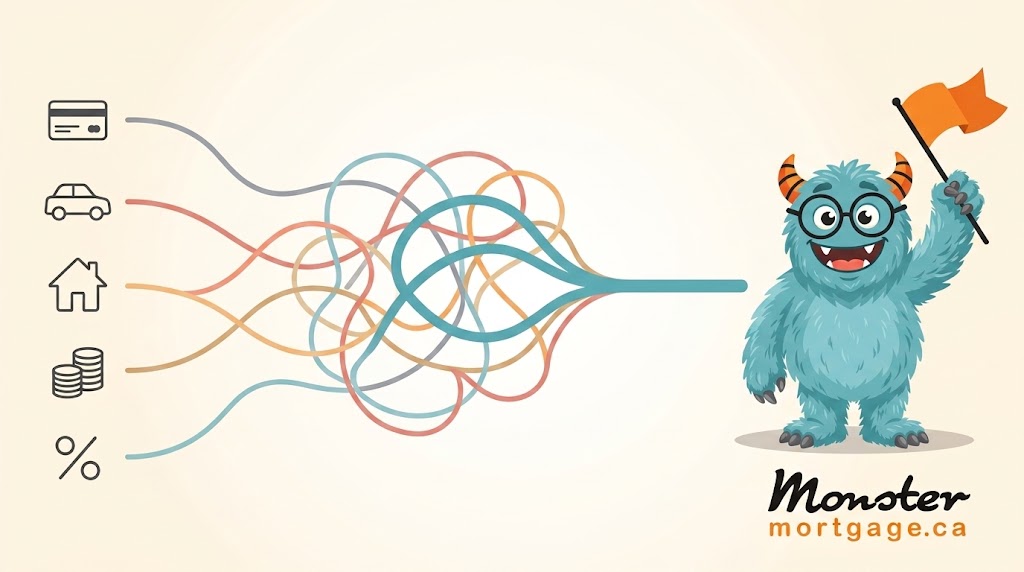
5 debt consolidation options in 2026 and how to pick one
If you’re juggling a few different balances right now, credit cards, a line of credit, maybe a personal loan, you’re not imagining the squeeze. More of your income is probably going toward minimum payments than it used to, and it’s a common reason homeowners start looking into debt consolidation. A lot of households are in the same position. It’s less about anyone doing something wrong and more about rates and costs shifting faster than budgets could keep up.
Canadian household debt hit a new high in the first quarter of 2026. Statistics Canada reported the household debt-to-income ratio at 179.6%, the sixth straight quarterly increase (StatCan, June 12, 2026). That works out to $1.80 owed for every dollar of disposable income. The household debt service ratio, the share of income going to required debt payments, also ticked up to 14.75%.
The good news is there are more ways to approach it than there were even five years ago. This guide walks through what debt consolidation actually changes and the lenders now competing for that business, banks, credit unions, and a growing fintech segment. It also covers how to think about paying down debt while still saving, and what it looks like on a real monthly budget.
TL;DR: Debt consolidation combines multiple debts into one loan or line, ideally at a lower rate. It only helps if the new terms are genuinely better and the freed-up cards don’t get run back up. Homeowners with equity typically get the lowest rates through a HELOC or refinance, averaging 3.96% vs. 8.40% for unsecured lines as of May 2026. Fintech and credit union lenders have expanded the unsecured options for those without equity. The healthiest approach splits any freed-up cash flow between extra debt pay down and rebuilding savings, rather than sending all of it to one or the other.
What debt consolidation actually does
Debt consolidation combines several debts, credit cards, lines of credit, a personal loan, into a single loan or line at a single rate. The goal is usually one or more of three things: a lower overall interest rate, one payment instead of several, or lower monthly payments through a longer amortization.
It’s worth being precise about what it doesn’t do. Consolidation doesn’t erase what you owe. If the new rate isn’t meaningfully lower, or the term stretches out enough, it can end up costing more even while the monthly payment looks smaller. The value of consolidation depends entirely on the rate and terms you actually qualify for, not the idea of consolidation itself.
The lender landscape has changed
A decade ago, “debt consolidation” mostly meant walking into a bank branch for a personal loan or line of credit. That’s still an option. RBC, TD, Scotiabank, BMO, CIBC and National Bank all offer one. But two other categories have grown significantly.
Credit unions have picked up market share specifically in this space. They often come with lower fees and more relationship-based underwriting than the big banks.
Fintech lenders are now a major part of the market. Companies like Borrowell, Fig, Fairstone, and Happen Bank offer online applications, fast approval decisions, and in some cases same-day funding. For someone comparing options at 11pm instead of during branch hours, that convenience is real.
The catch is rate variance. Canada’s federal criminal interest rate cap sits at 35% APR as of January 1, 2025 (Canada Gazette). Some subprime consolidation lenders price close to that ceiling, up to 34.95% for borrowers with damaged credit. That’s still legal, and still, for the right borrower, better than what they’re currently paying on multiple maxed-out cards. But it’s a long way from what a homeowner with equity can access.
That’s the split worth understanding before comparing individual companies: unsecured consolidation (personal loans, lines of credit, fintech products, balance transfer cards) versus secured consolidation through home equity.
| Option | Typical rate range | Speed | What it’s based on |
|---|---|---|---|
| Bank personal loan or line of credit | Prime-based, varies by credit profile | Days to weeks | Credit score, income |
| Credit union loan | Often below bank rates, varies by membership | Days to weeks | Credit profile, relationship |
| Fintech lender (online-only) | Wide range, up to 34.95% for subprime | Often same-day to 48 hours | Credit score, income, varies by lender |
| Balance transfer card | Promotional rate, reverts to standard card rate after a set period | Fast | Credit score |
| Home equity (HELOC, refinance, second mortgage) | Secured lines of credit averaged 3.96% as of May 2026; unsecured personal lines averaged 8.40% | Weeks | Home equity, income |
Rate figures above are sourced from Statistics Canada, Table 10-10-0006-01, May 2026 reference period.
The gap in that table is the point. As of May 2026, the average rate on a secured line of credit in Canada was 3.96%, against 8.40% for an unsecured personal line. That spread is why home equity remains the lowest-cost consolidation route for homeowners who have it, even as the fintech and credit union space has gotten more competitive at the unsecured end.
A quick chat with a broker can save you from comparing the wrong products against each other. Book a call with a MonsterMortgage.ca broker before you apply anywhere. A hard credit pull from the wrong lender is easy to avoid.
Paying down debt and still saving: it’s not either/or
A common assumption is that every spare dollar should go toward debt until it’s gone, and only then should saving start. In practice, that approach leaves people with zero cushion. The first unexpected expense, a car repair, a medical bill, a reduced work week, gets put right back on a credit card. The debt comes back, sometimes worse than before.
A more durable approach:
- Keep a small buffer, even while consolidating. It doesn’t need to be large. Even one or two months of essential expenses in a separate account reduces the odds of re-borrowing at a high rate the next time something goes wrong.
- Split the freed-up cash flow. If consolidation lowers your monthly payment by, say, $400, direct part of that toward extra principal payments and part toward rebuilding savings. Don’t send 100% of it to either.
- Avoid closing every old account immediately. Utilization, how much of your available credit you’re using, is a factor in your credit score. Closing accounts you’ve paid off can shrink your total available credit and push your utilization ratio up, even though your balance went down.
- Treat consolidation as a reset, not new room to spend. The most common way consolidation backfires is running the paid-off cards back up. The plan only works if the freed-up capacity stays unused.
The household debt service ratio nationally sits at 14.75% of disposable income going to required debt payments. If your own ratio is meaningfully above that, it’s a signal worth acting on, not a source of alarm, just information.
What it looks like on a monthly budget
Here’s a simplified, realistic scenario. Say a homeowner is carrying:
- $8,000 on a credit card at 20% interest
- $25,000 remaining on a car loan at 7%
- $12,000 on a line of credit at 10%
Total debt: $45,000. Blended monthly interest cost at those rates runs close to $380 a month, paying only minimums, before any principal is actually retired. Progress is slow because most of the payment is servicing interest.
Rolled into a home equity line at close to the current secured average of 3.96%, the interest portion on that same $45,000 drops to roughly $148 a month. Even accounting for a longer amortization and any lender or legal fees, the monthly cash flow difference is substantial. It often frees up $200 to $250 a month, depending on the specific terms.
That freed-up amount doesn’t have to disappear into daily spending. Applied consistently, it’s the difference between treading water on multiple cards and actually reducing the amount owed month over month, while still leaving room to rebuild a savings cushion.
This is illustrative, not a quote. Actual numbers depend on your specific balances, credit profile, home equity position, and the lender’s current rate.
Questions worth asking before you pick a debt consolidation method
- Do I have home equity to draw on, and how much?
- Is this debt a short-term spike (one bad month, an unexpected expense) or a structural gap between income and spending?
- What’s the real APR after fees, not just the advertised rate?
- Is the rate fixed or variable, and what happens to my payment if it moves?
- Am I keeping any buffer, or is every dollar of relief going straight back into spending?
There’s no single right answer. A fintech loan might be the right tool for someone without home equity who needs funds quickly. A HELOC or refinance is usually the lower-cost option for a homeowner who qualifies, but it ties the debt to the home and takes longer to arrange.
Where a mortgage brokerage fits in
The reason this comparison matters is that no single lender, bank, credit union, or fintech company, is going to tell you their competitor has a better offer. A mortgage broker’s job is different: compare your specific equity position, income, and credit profile across all of these categories, not just the one product a single institution happens to sell.
As a mortgage brokerage that Toronto homeowners turn to for debt consolidation, refinancing, and home equity solutions, MonsterMortgage.ca works with a network of 30+ lenders, including major banks, credit unions, and alternative lenders, plus in-house lending capacity. The comparison isn’t limited to what one branch can offer. We look at whether home equity is even the right lever to pull before recommending it.
Debt consolidation isn’t a single product. It’s a decision about which lender, which rate structure, and which trade-offs fit your specific situation. Getting that comparison right is worth more than any one feature of any one loan. If you’re weighing your options, speak with a MonsterMortgage.ca agent about what’s actually available to you.


