

Spousal buyout mortgage in Ontario: how to keep the home after a separation
TL;DR: A spousal buyout mortgage lets one owner keep the home by paying out the other owner with a new mortgage. It works only when the person staying can qualify on their own income and the paperwork is in place. An insurer-backed version can borrow more than a regular refinance, and the same approach can work for common-law partners, siblings and other co-owners. Check the penalty on your old mortgage, the new rate and land transfer tax before you agree on a payout figure.
When two people own a home together and one of them wants to keep it, the other owner has to be paid for their share. Many people do not have that much cash, so the money usually comes from a new mortgage taken out by the person who stays. This is called a spousal buyout mortgage. Lenders approve it only when the numbers work for one borrower instead of two.
This guide covers how the process works, how much you can borrow, what lenders ask for and the costs people overlook. Two terms come up throughout. Title is the legal record of who owns a property. Equity is what the home is worth minus what you still owe on the mortgage.
How a spousal buyout mortgage works
A spousal buyout mortgage pays off the old mortgage and covers the other owner’s share of the equity. Replacing an existing mortgage with a new one is called a refinance, so a buyout works like a refinance.
| Step | What happens | Who is involved |
|---|---|---|
| 1. Agree on the payout | Both owners settle on the home’s value and the other owner’s share. For married spouses, Ontario law generally divides the value of what each person built up during the marriage, a calculation called equalization, and counts the full value of the family home, known in law as the matrimonial home (Government of Ontario). | Each owner’s lawyer |
| 2. Value the home | An appraisal is a professional’s written estimate of what the home would sell for. The lender usually orders its own. | Appraiser, lender |
| 3. Apply for the new mortgage | The lender checks whether the person staying can carry the mortgage alone. | Mortgage broker, lender |
| 4. Close | The lawyers pay off the old mortgage, pay the other owner, and register the change so only the person staying is on title. | Lawyers |
Why a buyout can borrow more than a regular refinance
A spousal buyout mortgage can borrow a higher share of the home’s value when an insurer backs it. That share is the loan-to-value ratio (LTV): the mortgage as a percentage of what the home is worth. Most lenders cap a regular refinance at 80% LTV (Financial Consumer Agency of Canada). Borrowing above that requires mortgage default insurance, which protects the lender if a borrower stops paying. Three companies provide it in Canada: CMHC, Sagen and Canada Guaranty (OACIQ). You pay the insurance premium, usually by adding it to the mortgage.
Each of the three insurers sets its own rules, so buyout conditions can differ. Sagen publishes one example: a buyout policy that allows borrowing up to 95% LTV when one owner buys out the other. Under it, both owners must currently be on title, and the lender must keep proof of the sale: a purchase agreement, a finalized separation agreement or a court order. Sagen’s notice treats the buyout as a purchase transaction, in which the person staying buys the other owner’s interest. The policy applies regardless of the relationship between the owners (Sagen lender update). This route is optional: if the new mortgage stays at or below 80% LTV, a regular refinance needs no insurer. Ask your broker which insurer your lender uses and what its buyout rules require.
The table and graphic show how the limits play out on an $800,000 home with an equal split of the equity.
| Item | Amount |
|---|---|
| Home value (from the appraisal) | $800,000 |
| Existing mortgage | $560,000 |
| Equity (value minus mortgage) | $240,000 |
| Other owner’s half of the equity | $120,000 |
| New mortgage needed (existing mortgage plus payout) | $680,000, or 85% of the home’s value |
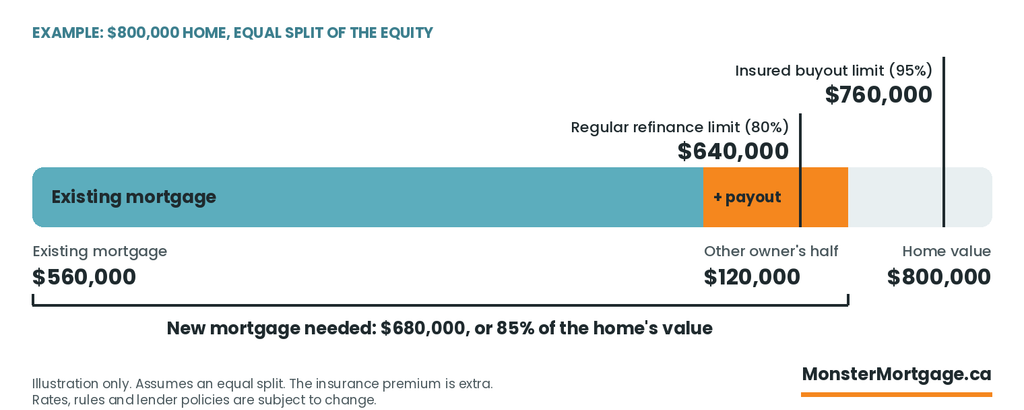
The regular refinance falls $40,000 short, and the insured buyout covers the gap. The insurance premium is added on top, so the final mortgage is a little larger. Your agreement sets the real split, which may not be equal.
Not sure how much you could borrow? Talk to a broker at MonsterMortgage.ca and we will walk through your numbers.
Qualifying on your own, and what to do if the numbers fall short
The person staying has to qualify alone, because the other owner’s income no longer counts. The lender looks at your income, credit history, existing debts and the new payment. It also applies the stress test, a check that you could still afford the payment if interest rates were higher. Banks apply it to a refinance, and a spousal buyout mortgage is one. Support payments you pay or receive are part of the picture, and lenders differ on how they count them.
If the numbers fall short, there are six common routes:
- Adjust the deal. A smaller payout, or a different split of other assets, can bring the new mortgage within reach. This is a negotiation between the owners and their lawyers.
- Add a co-signer. A co-signer is a person who signs the mortgage with you so their income counts too. They take on the debt as well, and lenders have their own rules on when they allow it.
- Use a lender that weighs equity more than income. Alternative lenders sit outside the big banks. They tend to charge higher rates and fees, and their terms are often shorter.
- If you are 55 or older, consider a reverse mortgage. A reverse mortgage can usually lend up to 55% of a home’s value to homeowners who are 55 or older, with no payments until the loan is due. Interest builds up on the balance and is repaid when you move out, sell or the last borrower dies. The limit also counts what you still owe on your mortgage, so it suits homes with little or no mortgage left (Financial Consumer Agency of Canada). HomeEquity Bank, a reverse mortgage lender, says its product can fund a buyout when the other owner agrees to come off title and a settlement agreement is in place (Investment Executive). Our post on reverse mortgage myths vs. facts explains eligibility and costs.
- If you need only a small amount, consider a HELOC or second mortgage. A home equity line of credit (HELOC) is a credit line secured by your home that you borrow from as you need it. A second mortgage is a separate loan registered behind your first mortgage. Either can cover part of the payout. A HELOC usually allows borrowing up to 65% of your home’s value, and second mortgage rates are usually higher than first mortgage rates (Financial Consumer Agency of Canada). Payments are still due, you still need to qualify, and the lender still has to agree to release the other owner from the existing mortgage. Reverse mortgage or HELOC compares the two.
- Sell the home and divide the proceeds. This is the fallback when no lender will approve the buyout.
If debts are what hold the numbers back, our guide to debt consolidation options explains how rolling them into one payment works.
What lenders ask for
Lenders ask for proof of the sale, proof of the home’s value and proof that the person staying can carry the mortgage. Have these ready before you apply:
- Proof of the buyout. For spouses this is usually a signed separation agreement, a written contract that sets out how property, debts and support are divided. Insurer policies such as Sagen’s also accept a purchase agreement or a court order, and your lender sets the final list.
- Independent legal advice. Each person gets advice from their own lawyer before signing the agreement, so that neither can later say they did not understand it.
- A current appraisal. A valuation done early in a separation can be out of date by the time you apply, so expect the lender to order its own.
- Your current mortgage statement. It shows the balance, the rate and the date the term ends.
- Income and debt documents for the person staying: recent pay stubs or tax documents, and a list of loans and credit cards.
Costs people overlook
Beyond the payout itself, three costs catch people off guard: a penalty on the old mortgage, a new interest rate on the whole balance, and land transfer tax. Legal fees, the appraisal and the mortgage insurance premium come on top, and lawyers and lenders set their own prices.
The prepayment penalty on your old mortgage
Paying off your old mortgage before its term ends can trigger a prepayment penalty. The term is the length of your mortgage contract, often five years, after which you renew or switch lenders. The penalty is usually the higher of two amounts: three months’ interest on what you owe, or the interest rate differential (IRD), which compares your rate with the rate lenders charge today for the time left on your term (Financial Consumer Agency of Canada).
Your lender’s penalty calculator or a written payout statement gives the exact number. Few people can time a separation around a renewal date, so ask for the figure early and build it into the numbers. There is no penalty once the term has ended, so if your renewal is close, compare the cost of waiting with the cost of paying.
A new rate on the whole balance
A spousal buyout mortgage is a new mortgage, so the whole balance is priced at today’s rates, not only the extra money you borrow. If your current rate is lower than today’s, the payment on the old balance can rise as well. The Bank of Canada held its policy rate on September 2 (Bank of Canada), yet fixed rates have risen because bond yields climbed in September (Wealth Professional). Our posts on the Bank of Canada hold and renewal vs refinance cover the rate backdrop in more detail.
Land transfer tax
Land transfer tax is a provincial tax paid when a property changes hands, based on the amount paid for it. Transfers between spouses or former spouses are taxable unless an exemption applies, and the exemption covers transfers that follow a written separation agreement or a court order (Government of Ontario). Properties in Toronto also carry a separate city land transfer tax, so ask your lawyer how both apply to your transfer.
Buyouts between common-law partners, siblings and other co-owners
A spousal buyout mortgage can work for owners who are not married, even though the name says spousal. Sagen’s policy covers any owners on title, so common-law partners, siblings, stepfamily and friends who bought together can use it, though other insurers and lenders may review non-spousal buyouts case by case. A common-law partner is someone you live with in a relationship without being married.
The legal rules for working out the payout are different. In Ontario, the Family Law Act’s property-sharing rules apply to married spouses, so common-law partners have no automatic right to an equalization payment. A partner who contributed to a home the other person owns may still have a claim, so get legal advice before you agree on a figure.
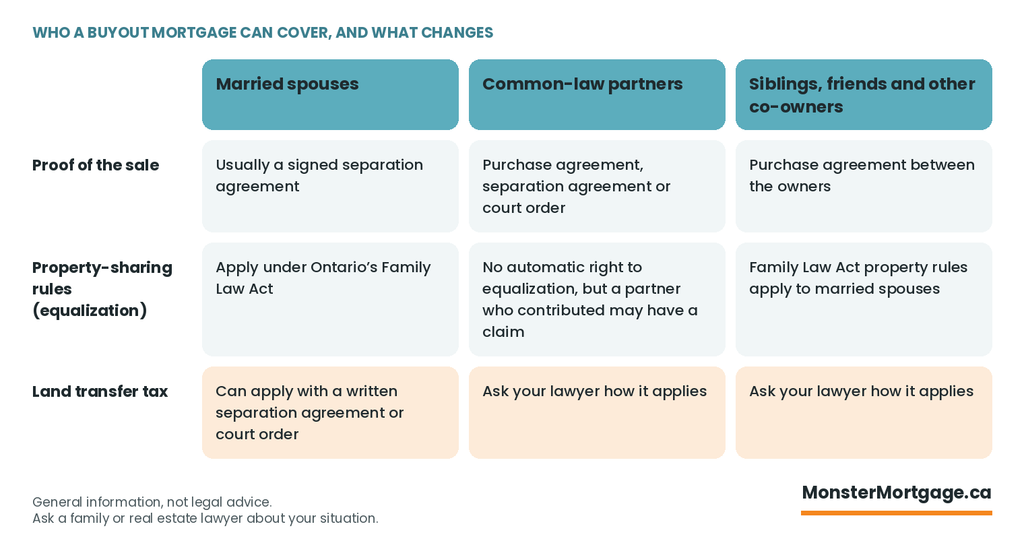
Qualifying on one income matters in every co-owner buyout, not only spousal ones. Two siblings who inherited a house together may agree that one should keep it, but the lender will release the other owner only once the sibling staying qualifies on their own income. Taking any name off a mortgage works this way: the lender has to agree, and it will want the person staying to qualify alone.
If you co-own a home and are working out how to part ways, talk to a broker at MonsterMortgage.ca before you settle on a number.
FAQ
Am I still responsible for the mortgage after we separate?
Yes, until the lender releases you. A separation agreement is a contract between the two of you, and it does not change the contract each of you signed with the lender.
What if we cannot agree on the buyout figure?
A buyout needs both owners to agree on the number. A family lawyer or a mediator, who is a neutral person that helps both sides reach an agreement, can help. A court can settle the figure if you cannot.
Does a buyout work if only one of us is on title?
Sagen’s policy requires both owners to be on title already, and other insurers set their own conditions. For married spouses, the matrimonial home carries legal rights whoever is on title, so a lawyer should confirm where the other person stands before you apply.
Talk to a broker about your buyout
A buyout works when a figure both owners accept, a lender willing to approve one borrower and the right paperwork all line up. Talk to a broker at MonsterMortgage.ca and we will review your goals and numbers and explain the options that fit. You can also call us at (416) 480-0234.
This article is general information, not financial or legal advice. Mortgage rates, rules and lender policies are subject to change. Speak with a licensed mortgage professional and a family or real estate lawyer about your situation.


